Flowers for a new generation - live in one month with AI as the pair programmer
How a long-time client's idea for reaching younger customers became our first project built systematically with AI from end to end - prototype, code, and content - while keeping every line reviewed and owned by us.
On paper, this was an ordinary project: a fresh start, a moderate scope, nothing technically exotic. What makes it worth writing about is how it was built. Each developer was paired with an AI assistant throughout the project. The result is the same kind of software we have delivered for more than fifteen years. We just got there sooner.
A long-time client with a new idea
The regional Interflora business has been our client for years. Some time ago, we built a completely new web application to support their operations across several countries, and life in the new store carried on with good momentum.
Meanwhile, a question had been turning over in the minds of the company’s leadership for several years: how to get closer to younger customers, the ones who rarely walk into a flower shop. The client shared their thinking with us, and to sharpen the ideas, we suggested starting the way we usually do - with a prototype.
A prototype makes it possible to visualise and validate ideas quickly, at a significantly lower cost in time and money than building a fully functional application. It is the cheapest place to be wrong.
Sharpening the idea with a prototype
The prototype turned out very thorough - with considerable help from AI. Our UX/UI designer experimented with several different AI tools along the way.
“We have used AI tools for prototyping before - it makes the work faster, smoother, and more affordable. In this project, the assistants did a solid job, but at a certain point, I still had to step in myself. The visual creativity you get out of AI tends to be fairly uniform.”
This is a pattern we keep seeing: AI moves quickly through the well-defined, well-bounded parts of the work, while taste, judgement, and the bigger picture stay firmly in human hands. With each iteration, the realistic prototype sharpened the idea further, until the client had a clear understanding of what they wanted. It was time to build.
Two developers, two AI assistants
By that point we had been trying out different AI assistants for months, both inside Codeborne and in our developers’ own side projects, and comparing their strengths and weaknesses at our weekly tech sessions. Now we had the opportunity to put AI to the test on a real project - one starting from scratch, with a moderate scope. The right conditions for a proper experiment.
One of Codeborne’s founders, who was on the development team, describes how it worked:
“We still program in pairs, so there were two people on the team. We continued to sit side by side and discuss things with each other, but each of us was actually paired with our own AI assistant, for which we used Claude. In one month the application was essentially ready to go live, which confirms what these tools are capable of. What is very important to note here is that all the code created in this project was reviewed by us - both the architecture and the security - because we put the Codeborne quality mark on it.”
The principle has not changed. The developer holds the wheel: they design the system, understand the client’s business, and own the code. AI carries the load on the parts that used to be slow. We do not ship code we don’t understand - not now, not in the AI era, not ever.
Draft first, sculpt after
What does this look like in practice, hour by hour? Over the course of the project, a clear working rhythm settled in.
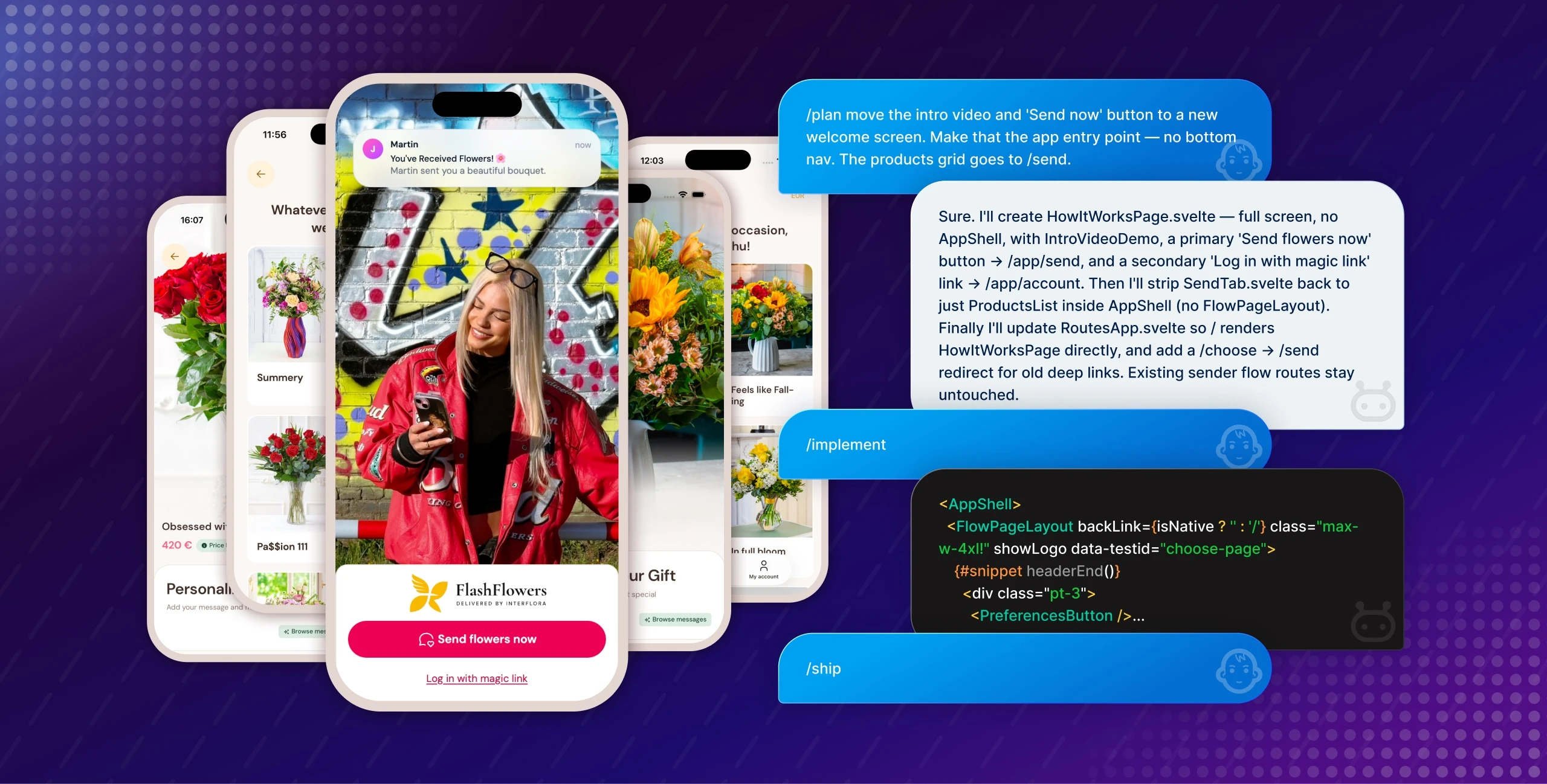
Rather than handing the assistant a complete specification upfront, the developers let Claude take a first pass at a problem and then pushed for cleaner designs from there. The first implementation was treated as a draft to react against, not as a final answer - ship, then sculpt. It is often faster to critique working code than to describe the perfect solution in advance, and seeing a concrete attempt sharpens your own thinking about what the right solution actually is.
The other half of the rhythm was restraint. AI assistants are eager - left alone, they tend to over-build. So the developer’s role kept shifting toward that of a domain-expert gatekeeper: running full development cycles with the assistant, then aggressively refining the output, reining in unnecessary complexity, and supplying the business facts and context that no model can guess - how this client’s flower deliveries actually work, what the regional market needs, which edge cases matter.
In other words, the craft did not disappear. It moved up a level: from typing the code to directing, questioning, and editing it.
How it went
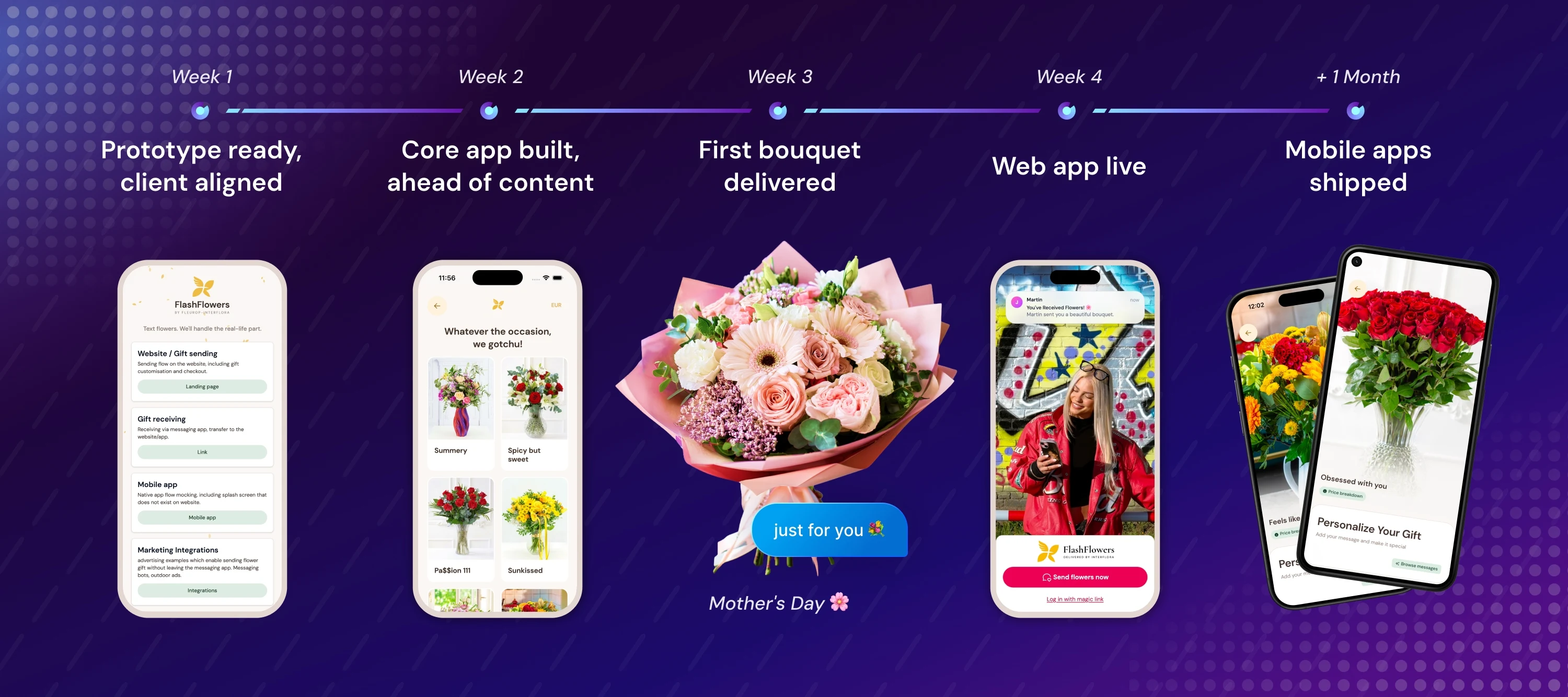
Our pace caught even the client by surprise. At times, software development moved ahead of content creation - a problem we were happy to have.
The proof is in the flowers: the first real bouquet has already been delivered. On Mother’s Day, the first mother received her bouquet through the new application. And once the web application was live, the mobile apps followed within the next month, built the same way, again with Claude as the pair partner.
What we learned
An hour was no longer enough. Our weekly iteration meetings normally run about an hour. This time we built so much each week that an hour was not enough to demonstrate everything to the client. A happy problem, you could say.
Added capability opens the door to feature creep. Because so much capability was suddenly within easy reach, we built user stories we would probably never have started without AI. The back-office, for example, gained a great deal of tooling simply because it came so easily. Worth weighing each time whether a feature is needed or just easy - but it also means that more of what a client imagines now fits in the budget.
AI assistants genuinely work. There is no way around it: under sufficient supervision, they already produce very good code today, making it possible to offer clients a very good result, faster.
The shop is live
If you would like to see what came of it all, the new shop is live at flashflowers.com. The idea that set everything in motion is right there in the product: pick a bouquet, add a note, and send it on as a link in seconds, with real flowers delivered for real. Have a go yourself. Someone in your life is one bouquet away from a very good day.
Curious how this could work for your business?
The tools are sharper, but the craftspeople are the same. If you have a manual process to automate, a system to modernise, or an idea you would like to see as a working prototype sooner than you thought possible, let’s have a straightforward conversation about where this new way of working might fit.

Our recent stories
Flowers for a new generation - live in one month with AI as the pair programmer
How a long-time client's idea for reaching younger customers became our first project built systematically with AI from end to end - prototype, code, and content - while keeping every line reviewed and owned by us.

A bank built in 8 months - licence confirmed, deadline met
Build or buy? When the client came to us, that question was still open. We recommended building. No vendor lock-in, no paying for features you'll never use, no waiting on someone else's roadmap. A codebase you own. A product you control. They agreed. That put more weight on us - and we were fine with that.
The story of Mihkel and Misha creating the Fussball app
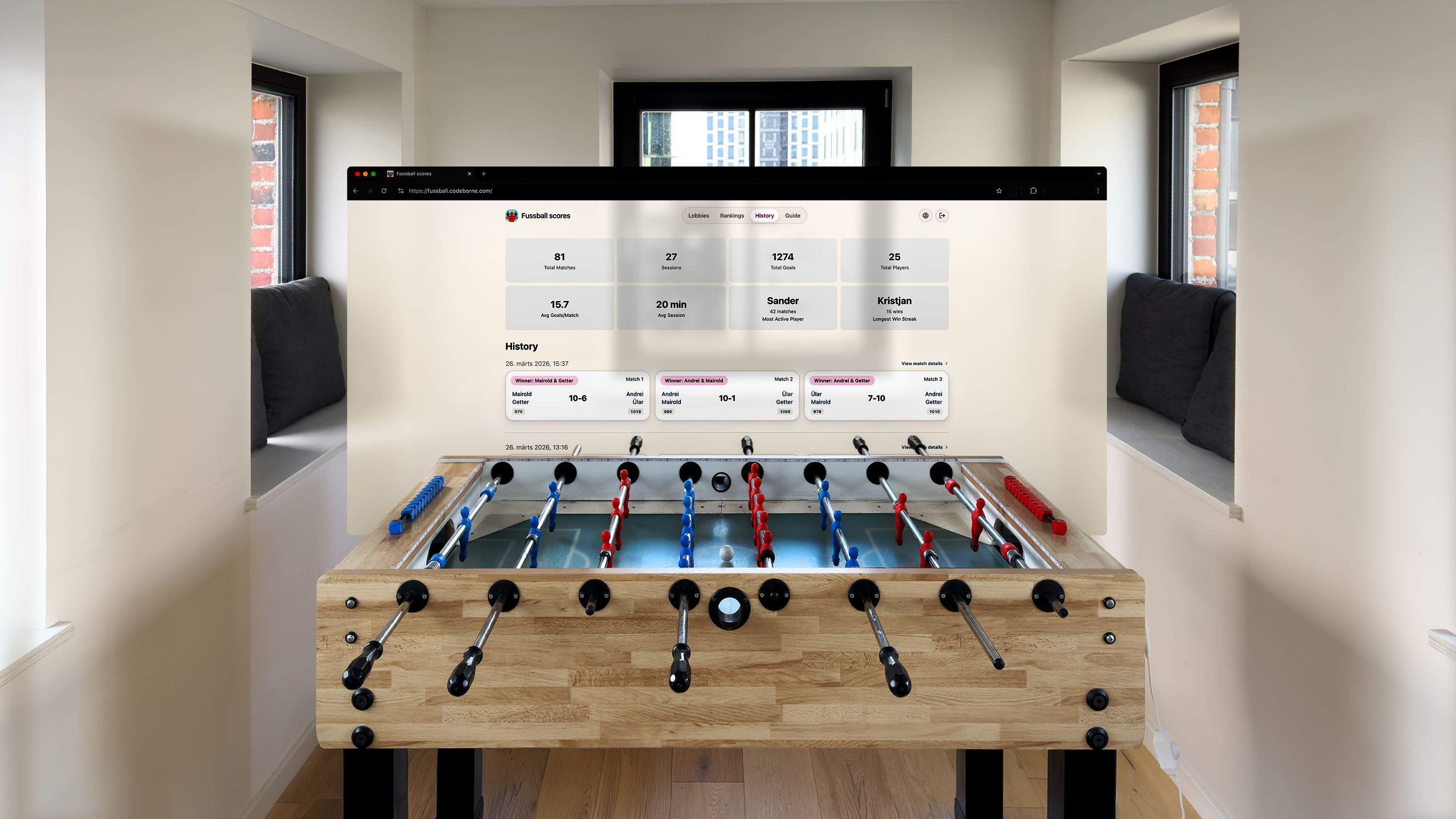
We now have our own internal app called Fussball. We talked to its creators, Misha and Mihkel, about what it does and what motivated them to spend their free time building it.